 How-to
How to Heal Your Relationship With Attachment-Based Therapy
Last Updated: 2 November 2026
Quick Summary
Attachment-based therapy for couples is a structured form of counselling that traces today's relationship conflicts back to the attachment patterns you learned in early life, then works to rebuild trust and emotional safety from that foundation. An attachment-based therapist helps you see those expectations clearly, then practise new ways of responding.
- Sessions blend mapping each partner's attachment history, identifying repeating conflict patterns and practising new responses.
- Anxious partners push for reassurance while avoidant partners withdraw, and both are protecting an attachment need.
- Start with a five-minute daily check-in and an agreed pause signal before moving to the pattern map.
- Progress shows as faster repair, shorter cool-downs and the same argument no longer recurring in the same shape.
- Stop home exercises and seek professional help if conflict involves fear, control or coercion.
Table of Contents
- What Attachment-Based Therapy for Couples Actually Involves
- How Attachment Styles in Relationships Shape the Way You Fight and Repair
- Attachment-Based Therapy Techniques for Couples You Can Try at Home
- Attachment-Based Therapy vs Traditional Therapy: What Changes in the Room
- How Long Does Attachment-Based Couples Therapy Take?
- What to Expect in Sessions and How Progress Is Measured
- When Attachment Work Needs Professional Support
- Book an Attachment-Based Couples Session With IABCT
- Frequently Asked Questions
What Attachment-Based Therapy for Couples Actually Involves
Attachment-based therapy for couples is a structured form of counselling that traces today's relationship conflicts back to the attachment patterns you learned in early life, then works to rebuild trust and emotional safety from that foundation.
The core idea is simple. Humans are wired to seek closeness. How safe that closeness felt in childhood shapes what you expect from a partner now.
Sessions usually blend three things:
- Mapping each partner's attachment history and current style
- Identifying the repeating patterns that trigger conflict
- Practising new responses in a safe, guided setting
This work is not about blame. It is about understanding. Early caregiving relationships are widely understood to shape adult bonding, which is why the past keeps showing up in the present.
How Attachment Styles in Relationships Shape the Way You Fight and Repair
Attachment styles in relationships describe the default way you seek closeness, handle conflict and repair after distance.
- Secure attachment: You can ask for what you need and tolerate disagreement without panic.
- Anxious attachment: You reach harder when your partner pulls back, sometimes escalating to get a response.
- Avoidant attachment: You pull back when things get intense, needing space to feel safe.
Anxious, Avoidant and Secure Patterns in Everyday Conflict
Picture the classic loop. One partner wants more reassurance and pushes. The other feels crowded and withdraws. The pusher pushes harder.
Neither is the villain. Both are trying to protect an attachment need. The anxious partner needs to know the bond is intact.
Secure couples still argue. The difference is they repair faster. They trust the bond will survive the disagreement, so conflict feels less like a threat.
Attachment-Based Therapy Techniques for Couples You Can Try at Home
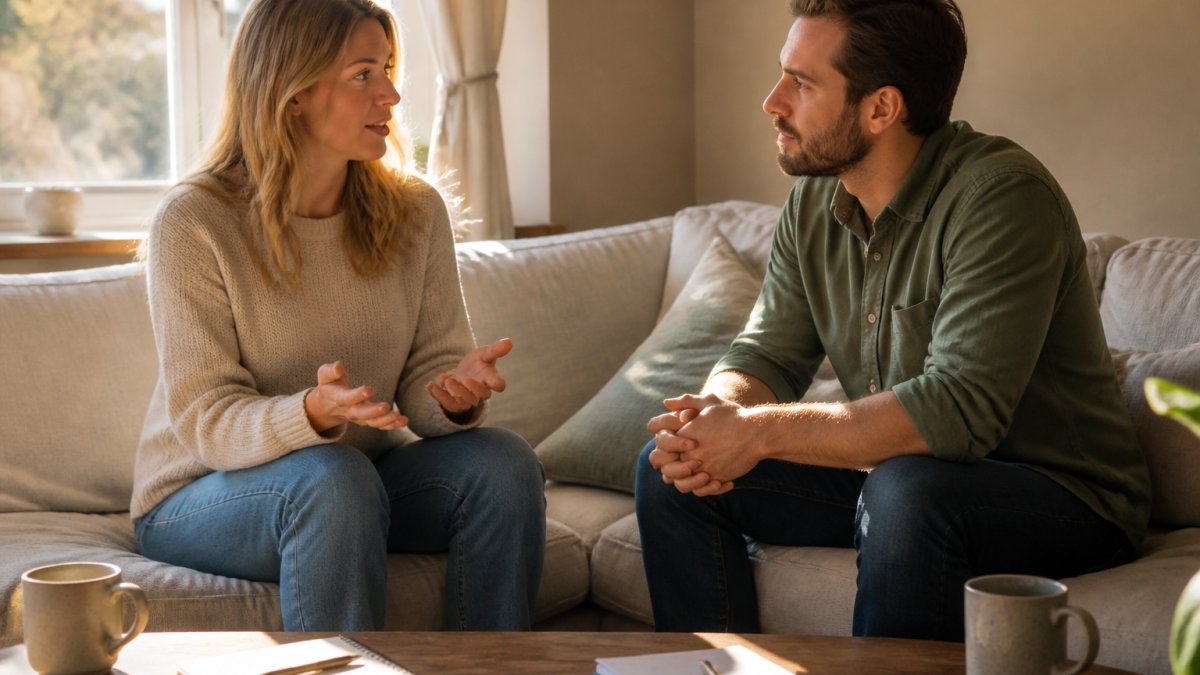
Attachment-based work is usually sequenced so that safety comes first, then insight, then repair. Attachment-based work asks you to notice a need, signal it safely, and repair when the signal goes wrong.
Before you start: agree the ground rules
Set aside 20 minutes when neither of you is hungry, tired or mid-argument. Agree three rules: no fixing, no scoring points, and either partner can call a pause without it counting as walking away. If either of you has a history of trauma or feels unsafe in conflict, speak to a qualified therapist before trying these, see the safety section below.
Stage 1, Build the safety signal (weeks 1-2)
- The daily check-in. Five minutes each evening. Each partner names one feeling and one need, using 'I' statements. The listener reflects back what they heard before responding. This builds the basic attachment move: reach, and be received.
- The pause signal. Agree a word or hand gesture that means 'I need a break, not an exit.' Use it, then return within an agreed time, 20 minutes is common. The return is the attachment repair; the pause alone is not.
Stage 2, Map the pattern (weeks 2-4)
- The pattern map. Write down your last three arguments separately, then compare. Look for the same trigger underneath each one, often a moment one partner felt dismissed and the other felt crowded. Name the loop without blaming either side.
- The reaching statement. Practise: 'When you do X, I feel Y, and what I need is Z.' Keep it to one sentence. The aim is to signal a need, not to win the point.
Stage 3, Practise repair (weeks 4+)
- The repair attempt. After a disagreement, name one thing you understand about your partner's reaction before defending your own. Repair is not apology; it is showing the bond survived the rupture.
- The two-minute hold. Sit close and take turns speaking for two minutes each about something ordinary, the day, a worry, a plan, while the other listens without interrupting. This is a low-stakes rehearsal for being heard.
These are not a substitute for therapy. They are a way to rehearse the moves an attachment-based therapist would guide you through, and to notice which stage keeps tripping you up.
The at-home exercises are sequenced into three stages, each with its own timing and purpose.
| Stage | Timing | Exercise | What to do |
|---|---|---|---|
| Stage 1: Build the safety signal | Weeks 1-2 | Daily check-in | Five minutes each evening; name one feeling and one need |
| Stage 1: Build the safety signal | Weeks 1-2 | Pause signal | Agree a word or gesture; return within an agreed time, often 20 minutes |
| Stage 2: Map the pattern | Weeks 2-4 | Pattern map | Write down your last three arguments separately, then compare |
| Stage 2: Map the pattern | Weeks 2-4 | Reaching statement | 'When you do X, I feel Y, and what I need is Z' |
| Stage 3: Practise repair | Weeks 4+ | Repair attempt | Name one thing you understand about your partner's reaction first |
| Stage 3: Practise repair | Weeks 4+ | Two-minute hold | Sit close; take turns speaking for two minutes while the other listens |
Attachment-Based Therapy vs Traditional Therapy: What Changes in the Room
Attachment-based therapy vs traditional therapy comes down to focus. Traditional approaches often target symptoms and thought patterns.
In a CBT-style session, you might examine a thought and test it against evidence.
For a deeper comparison of how this plays out against a well-known model, read our guide on attachment-based therapy vs CBT.
These approaches are not necessarily rivals, and many therapists blend them.
How Long Does Attachment-Based Couples Therapy Take?
There is no fixed timeline for attachment-based couples therapy. How long it takes depends on the depth of the patterns, how long they have been running, and how consistently both partners engage.
Progress is rarely linear. Couples often notice small shifts first, like a shorter cool-down after an argument. Those small shifts compound. We would rather see steady, real change than a rushed finish.
What to Expect in Sessions and How Progress Is Measured
Your first session is mostly about understanding, not fixing. A typical attachment-based couples therapist will ask about your relationship history, your families of origin, the patterns you notice now, and what each of you hopes will change. No one is asked to relive trauma before they are ready, and either partner can say 'I'd rather not go there yet' without derailing the work.
How sessions are usually structured
Across the early sessions, expect a mix of:
- Assessment. Separate and joint conversations about attachment history, current triggers and safety. Some therapists use a structured attachment interview or questionnaire; others rely on guided conversation. Ask which they use.
- Mapping the loop. The therapist helps you see the repeating pattern, who reaches, who withdraws, what each is protecting, as it shows up in the room.
- Practising new responses. Guided exercises in session, then between appointments. The therapist coaches, interrupts and slows things down so new responses can take hold.
What progress actually looks like
Progress is often measured through your own reports rather than a scoreboard. Useful markers to track:
- Repair happens faster, the cool-down after an argument shortens.
- Conflict feels less like a threat to the bond and more like a problem to solve.
- Each partner feels safer reaching for the other, and more able to say what they need without escalating.
Questions worth asking your therapist
- What training do you have in attachment-based or emotionally focused couples work?
- How do you assess safety, and what would make you recommend individual therapy first?
- How will we know it is working, and how often will we review that?
There is no fixed timeline, and anyone who promises one is guessing.
When Attachment Work Needs Professional Support
Some situations call for more than home exercises. If conflict involves fear, control or coercion, or if either partner feels unsafe, stop the DIY work and seek professional help.
Attachment-focused exercises are also not appropriate when:
- There is active abuse or intimate partner violence
- Either partner is in acute crisis or untreated severe mental illness
- Trauma memories are surfacing faster than you can manage
If you are unsure, ask. A qualified therapist can assess whether couples work is the right fit or whether individual support should come first.
Book an Attachment-Based Couples Session With IABCT
Choosing a therapist matters as much as choosing an approach. Look for training in attachment theory, a trauma-informed stance, and a style that feels safe to both partners. At IABCT, our clinicians are trained in Dr Patricia Crittenden's Dynamic Maturational Model of attachment and adaptation, and we offer sessions via Zoom or in person.
If you are ready to understand your patterns and rebuild the bond, we are here to help. Our integrated, evidence-informed approach focuses on emotional regulation, communication and lasting connection.
Frequently Asked Questions
What is attachment-based therapy for couples?
Attachment-based therapy for couples is a form of counselling that looks at how your early caregiver relationships shaped the way you connect, trust and respond to conflict as an adult. Rather than only teaching communication skills, it works on the underlying attachment needs driving the argument, such as the need for reassurance or space. Sessions explore repeating patterns, build emotional safety and help partners respond to each other in ways that feel secure. It draws on models including emotionally focused therapy and the Dynamic Maturational Model of attachment and adaptation.
Can attachment-based therapy help if only one partner will attend?
Yes, individual work can still shift a relationship dynamic. When one partner changes how they respond in a repeating cycle, the cycle itself changes, and the other partner often adjusts without ever sitting in the room. Attachment-based therapy techniques for couples, such as naming your own trigger before reacting and stating an attachment need directly, can be practised alone. A therapist can also help you decide when to invite your partner in and how to raise it without it landing as an accusation.
How is attachment-based therapy different from traditional couples therapy?
Traditional couples therapy often focuses on communication skills, negotiation and behaviour change, which is useful groundwork. Attachment-based therapy goes a layer deeper, treating the conflict as a signal of unmet attachment needs and old relational wounds. It asks why the same fight keeps returning, then works on the bond itself so the skills have somewhere to land. Many therapists blend both approaches, and a good clinician will explain which model they are using and why.
I'm worried that talking about my past will make things worse. Is that a risk?
Discussing early experiences can bring up strong emotion, and a trauma-informed therapist paces the work so it stays manageable rather than overwhelming. You are not asked to relive events in detail; the focus is on recognising patterns and building regulation. Tell your therapist if a session leaves you unsettled, and ask how they handle between-session support. If you have significant trauma, ask whether they are trained to work with it or will refer you for individual therapy alongside couples work.
The hardest part is often the first conversation. If you want to understand your attachment patterns and build a relationship that feels safer, IABCT can guide you through it with trauma-informed, attachment-based counselling, available online or in person, backed by specialist training in the Dynamic Maturational Model. Call now to book your first session and start the work toward stronger, steadier connection.