 Ultimate guide
Attachment-Based Therapy for Families Explained
Last Updated: November 5, 2026
Quick Summary
Attachment-based therapy for families is a structured talking therapy that treats the relationship between parents and children, or between partners, as the foundation for emotional wellbeing. It works from the principle that many family difficulties trace back to early patterns of connection, and that those patterns can be reshaped with the right support.
- The therapist maps attachment patterns across generations, helping parents see how their own childhood shapes current reactions.
- Sessions blend methods such as emotion-focused therapy, relational repair and coached caregiver sensitivity rather than one script.
- Attachment-based work treats the relationship itself as the client, so sessions usually involve more than one family member.
- It is most often used in adolescence, where the parent-teen relationship is seen as the strongest lever for change.
- Where there is current family violence or coercive control, joint sessions can increase risk and safety planning takes priority.
Table of Contents
- What Attachment-Based Therapy for Families Actually Involves
- Attachment-Based Therapy Techniques in Practice
- Attachment-Based Therapy vs Traditional Therapy: What Changes
- Attachment-Based Therapy for Parents and Teenagers
- Who the Approach Suits, and When It May Not Be the Right Fit
- Attachment-Based Therapy Duration and How Progress Is Measured
- Finding a Qualified Attachment-Based Therapist and Understanding Costs
- Book an Initial Conversation with IABCT
- Frequently Asked Questions
What Attachment-Based Therapy for Families Actually Involves
Attachment-based therapy for families is a structured talking therapy that focuses on the bond between parents and children, or between partners, as the foundation for emotional wellbeing. Attachment-based approaches work from the principle that many family difficulties trace back to early patterns of connection, and that those patterns can be reshaped with the right support.
The approach is not about blaming parents. It is about understanding how cycles of reaching out and pulling away become established, and how they can be interrupted.
How Attachment Theory Shapes the Work
Attachment theory holds that children develop expectations about relationships based on how consistently and sensitively caregivers respond to their needs. When caregiving is warm and predictable, a child tends to develop secure attachment: a settled confidence that others are available and that the self is worthy of care.
When caregiving is inconsistent, frightening or emotionally unavailable, insecure attachment patterns can form. These patterns often persist into adulthood and shape how people manage closeness, conflict and trust.
In family work, the therapist maps these patterns across generations. A parent who withdraws during conflict may be repeating what they learned as a child. Recognising that cycle is usually the first step towards changing it.
Attachment-Based Therapy Techniques in Practice
Sessions blend several recognised methods rather than following a single script.
Another core element is relational repair. The therapist guides family members through structured conversations about past hurts, with clear rules for listening and responding. The aim is not to relitigate old arguments but to help each person feel heard.
Caregiver sensitivity and emotional availability are also built deliberately. Parents practise noticing bids for connection and responding to them, sometimes in the session itself, with the therapist coaching in real time. Attachment theory research overview explains how these early patterns form.
Attachment-Based Therapy vs Traditional Therapy: What Changes
The central difference is where the therapy locates the problem. Attachment-based work treats the relationship itself as the client, so sessions usually involve more than one family member.
Traditional approaches such as CBT tend to be more structured and present-focused, targeting specific symptoms. Attachment-based work is more exploratory and looks further back, asking how current difficulties connect to early relational experience.
Neither is superior across the board. Attachment-based work tends to suit people whose difficulties are bound up with how they relate to others. Many clinicians combine elements of both. For a fuller comparison, read our article on attachment-based therapy vs CBT.
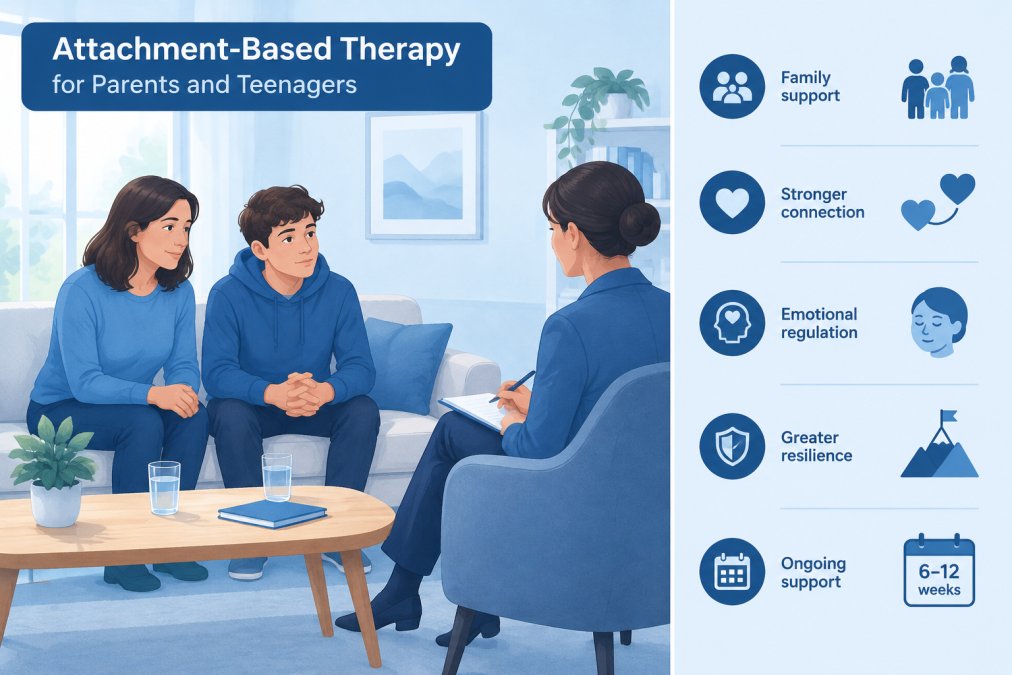
Attachment-Based Therapy for Parents and Teenagers
Adolescence is where attachment-based family therapy is most often used, particularly when a young person is withdrawn, angry or showing signs of depression.
A frequent pattern in these sessions is the pursue-withdraw cycle: one person pushes for conversation while the other shuts down. Naming that cycle out loud, with both present, often lowers the temperature in the room. Headspace guidance on supporting a young person notes that family connection is a protective factor for adolescent mental health.
If this pattern sounds familiar, our page on when one partner wants to talk and the other pulls away describes it in more detail.
Who the Approach Suits, and When It May Not Be the Right Fit
Attachment-based family therapy is not a universal fit, and a careful clinician will assess suitability before committing to the model. The approach tends to work best where family members are willing to attend, where there is some baseline safety in the home, and where the difficulties are bound up with relational patterns rather than an acute psychiatric crisis.
It is often considered for adolescent depression and anxiety, parent-teen conflict, couples in distress, and adults carrying the effects of childhood trauma. It can also help families navigating separation, step-family transitions or the aftermath of a rupture that has left everyone guarded.
When Family Involvement May Be Unsuitable
There are situations where bringing family members together is not the right first step. Where there is current family violence, coercive control or an active safeguarding concern, joint sessions can increase risk rather than reduce it.
A clinician will usually say plainly when the model is not indicated rather than proceed. That is a sign of good practice, not rejection.
Watch out: if a family member is attending under pressure and does not want to be there, sessions can stall or become another arena for conflict. A therapist should raise this early rather than letting resentment build.
Confidentiality and Safety in Family Sessions
Confidentiality works differently in family work than in individual therapy. The therapist holds the family as the client, which means information shared in the room is generally available to the family group. Practitioners typically explain at the outset what will be kept private, what will be shared, and what would prompt a disclosure to protect someone's safety.
Where a young person discloses risk, the therapist will usually discuss with them how and when parents will be informed, rather than going behind their back. This balance, between a young person's trust and a parent's need to know, is a core clinical skill in this work.
When Urgent or Specialist Support Is Needed
Attachment-based therapy is not an emergency service. If someone is at immediate risk of harm, contact emergency services on 000. For crisis support, Lifeline is available on 13 11 14, and Kids Helpline on 1800 55 1800 for young people. A GP can also advise on urgent mental health pathways and referrals.
Where specialist input is needed, for example, where there are complex trauma histories, eating disorders or significant psychiatric illness, attachment-based work may run alongside other treatment rather than replace it. A good therapist will coordinate with the wider care team rather than work in isolation.
Attachment-Based Therapy Duration and How Progress Is Measured
Attachment-based family therapy may be delivered in blocks, and total length depends on complexity. Progress varies between families, and entrenched patterns often take longer to shift.
Progress can be tracked through agreed treatment goals. Clinicians look for changes in how quickly a family repairs after conflict, whether bids for connection are noticed, and whether the young person is engaging more openly.
Periodic reviews where you discuss what is working are a reasonable expectation. If nothing is shifting after a reasonable block of sessions, a good therapist will say so and consider a different approach.
| Question | What to expect |
|---|---|
| How long per session? | Typically around an hour, with family sessions sometimes longer |
| How often? | Usually weekly to begin with, spacing out as things settle |
| How is progress judged? | Agreed goals, repair speed, engagement, and family feedback |
| What if it is not working? | A review and a change of plan, not endless continuation |
Finding a Qualified Attachment-Based Therapist and Understanding Costs
Finding the right therapist is its own piece of work, and it is worth doing carefully. Attachment-based family therapy is a specific model, not a generic label, so the first task is to distinguish it from general attachment-informed counselling.
Distinguishing ABFT from General Attachment-Informed Therapy
Many clinicians describe themselves as attachment-informed, which may mean they draw on attachment ideas in individual work. Attachment-based family therapy proper is a structured family model with defined stages, tasks and a treatment target, usually the parent-teen relationship.
A useful question is: "Do you work with the family together, and what does a typical course of sessions look like?" A clinician trained in the model will describe stages, separate conversations with parents and young people, and joint sessions aimed at repair. A general counsellor may offer family sessions but without that structure.
Questions to Ask Before Committing
Many practitioners welcome a short enquiry call. Useful questions include:
- What training have you completed in attachment-based family therapy, and with which training body?
- Are you registered with a recognised professional body?
- How do you handle confidentiality when working with a young person and their parents?
- What is your approach if a family member does not want to attend?
- How do you review progress, and what happens if the approach is not working?
You can check a practitioner's background before enquiring. Our therapist profile sets out training and approach, and our therapy services explain what we offer.
Costs, Funding and Practical Logistics
Pricing depends on the clinician, session length and format. For current fees, please contact IABCT directly or check the website.
Medicare may offer a rebate for sessions with eligible mental health professionals under a GP Mental Health Treatment Plan. Private health insurance may also cover part of the cost depending on the policy.
Session length and frequency are agreed with your clinician when your plan is set.
Watch out: a low fee is not a substitute for proper training. If a clinician cannot describe their model or supervision arrangements, that is worth weighing carefully.
Book an Initial Conversation with IABCT
Changing entrenched family patterns is difficult to do alone, and it often shifts more readily with someone guiding the conversation.
At IABCT, we offer trauma-informed, attachment-based counselling for individuals, couples and families, grounded in the Dynamic Maturational Model of attachment and adaptation. Sessions are available via Zoom or in person, and we work with individuals, couples and families. You can contact us to arrange an initial conversation.
Get started with IABCT and take the first step towards understanding the patterns that shape your relationships.
Frequently Asked Questions
How is attachment-based therapy different from traditional therapy?
Traditional talking therapy often focuses on managing symptoms such as low mood or anxiety in the individual. Attachment-based therapy looks at the relationship patterns underneath those symptoms, including how you learned to seek comfort and how safe closeness feels. Sessions may involve family members, not just the person in distress, because the aim is to change how the family connects. That shift in focus is why attachment-based therapy can help when previous individual work felt useful but did not change how relationships played out at home.
How long does attachment-based family therapy take?
There is no fixed number of sessions. Attachment-based therapy duration depends on the complexity of the family's history, how many people attend, and the goals you set together. Progress varies between families, and longstanding patterns and trauma often take longer to shift. A therapist should review progress with you at regular intervals so you know whether the work is helping and can adjust the plan. Ask about expected timeframes at the first appointment rather than assuming a set figure.
Can attachment-based therapy help parents and teenagers who are struggling to communicate?
Yes, this is one of its most common uses. Attachment-based therapy for parents and teenagers focuses on rebuilding trust and emotional safety so a young person feels heard rather than managed. Sessions may include the teenager alone, the parents alone, and joint conversations, depending on what the therapist recommends. The work addresses the cycle where a teenager withdraws and a parent pushes harder, or the reverse. It is not a quick fix, but it gives both sides a structured way to practise new responses with support.
What should I look for in a qualified attachment-based therapist?
Ask about specific training in attachment-based models, not just general counselling qualifications. A credible therapist should be able to name the clinical model they use, explain how they assess attachment patterns, and describe their supervision arrangements. Ask whether they are registered with a recognised professional body and how they handle safety concerns if trauma or suicide risk comes up. It is reasonable to ask about their experience with your particular situation, whether sessions are available online or in person, and how fees and cancellations work before you commit.